
What Is Scoliosis?
Scoliosis is a condition in which the spine curves laterally, taking the shape of a “C” or “S”. When an X-ray shows a spinal curve of even 10 degrees or more, scoliosis is confirmed, and this can affect people of all ages.
From behind, a normal spine is straight, in line from the base of the neck to the pelvis. With scoliosis, that line shifts to one side or the other and can affect the upper, middle, or lower back. Because the vertebrae also have a rotational component, it is not just a forward or backward deviation but a three-dimensional one and can present as a raised shoulder blade, an uneven waist or a prominent rib on one side.
The most common type is adolescent idiopathic scoliosis, which typically develops between the ages of 10-18 during growth spurts. The word “idiopathic” means that a specific cause has not been found, and it is important to note that this is not caused by heavy backpacks, poor posture or anything a parent or child can do. Scoliosis can also begin in early childhood, and adults can develop new curves as they age, so the condition is by no means limited to the young.
Can Scoliosis Get Worse Over Time?
Yes, scoliosis can progress over time, but this does not happen to everyone. The likelihood of a curve worsening depends on several factors.
Children and teenagers who are still growing may have a greater risk of progression, particularly during rapid growth spurts. Once one has stopped growing, the condition usually stabilizes, although larger curves have the potential to continue to change throughout life, and adults can also develop scoliosis later in life as the discs and joints of the spine gradually wear. The changes are generally slow and can be accompanied by stiffness and pain in the back.
This is why regular check-ups are important. Early detection of progression helps prevent surprises later. As it is impossible to tell what a curve will do based on a single measurement, a clinical examination is always the best method.
Recognizing Scoliosis in Children
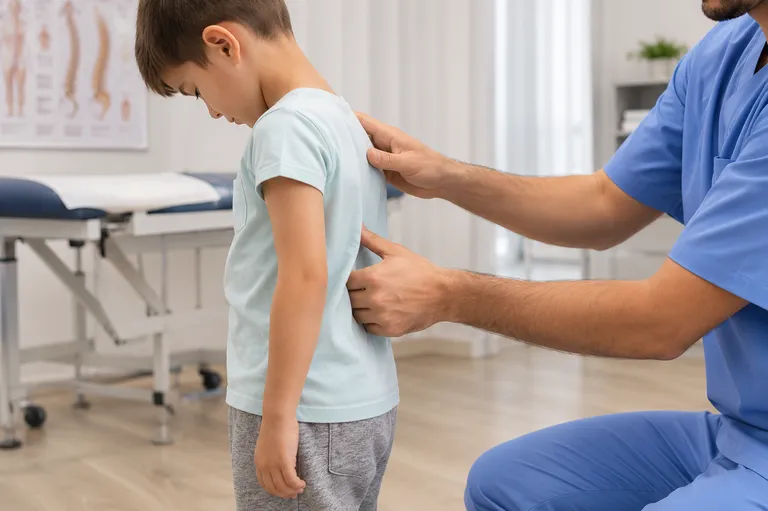
Parents are often surprised to find out that scoliosis tends to develop without any sort of pain. This means that the first signs will be visual rather than physical, making it easy to simply observe at home while the child is changing clothes.
The following are the most typical signs that you should watch out for:
- Shoulders that look uneven
- An uneven pelvis and hips
- An uncentered head over the pelvis
- Clothes that are uneven or hang unevenly
- A rib prominence or fullness on one side of the back
You can do a simple test for signs of scoliosis right at home.
Ask your child to stand with their feet together and their back uncovered.
- Tell them to slowly bend forward until they nearly touch their toes, allowing their arms to hang freely.
- From behind and from the side, observe whether one side of their ribcage or lower back is higher than the other.
Of course, this test can’t confirm or deny that there is scoliosis, but it should be an adequate sign to have a professional take a look as soon as possible.
We personally recommend contacting Scoliosis GTA if you notice any of these symptoms, as we believe it is better to be prepared than not. Having an assessment done doesn’t mean that you are immediately going to have to do any treatment; it just puts you in a better position overall.
Concerned About Scoliosis?
If you have noticed a change in your child’s posture, or have been diagnosed and want to know your options, it is completely normal to feel a little overwhelmed
A consultation at Scoliosis GTA is meant to put those worries at ease, allowing you to ask whatever questions you have in a stress-free environment, to discuss what you and your child have observed, and understand your situation.
Our treatments are meant to help manage the curve and are based on the individual’s situation and not just the severity of the curve. After a thorough evaluation, options such as the SpineCor brace or the ScoliBrace may be discussed as possibilities for treatment, along with other options depending on the patient’s age, curve and specific situation.
Mississauga (West): 6535 D Mississauga Rd, Mississauga, ON L5N 1A6
Newmarket (North): 11A-1100 Gorham St, Newmarket, ON L3Y 8Y8

Need More Information?
Health decisions regarding patients with scoliosis can be difficult. Scoliosis GTA now offers sufferers with great non-surgical options. Call today to book a Free Consultation.
Making scoliosis healthcare decisions for a child can be overwhelming. Scoliosis GTA provides non-surgical treatment options for children. Get in touch today